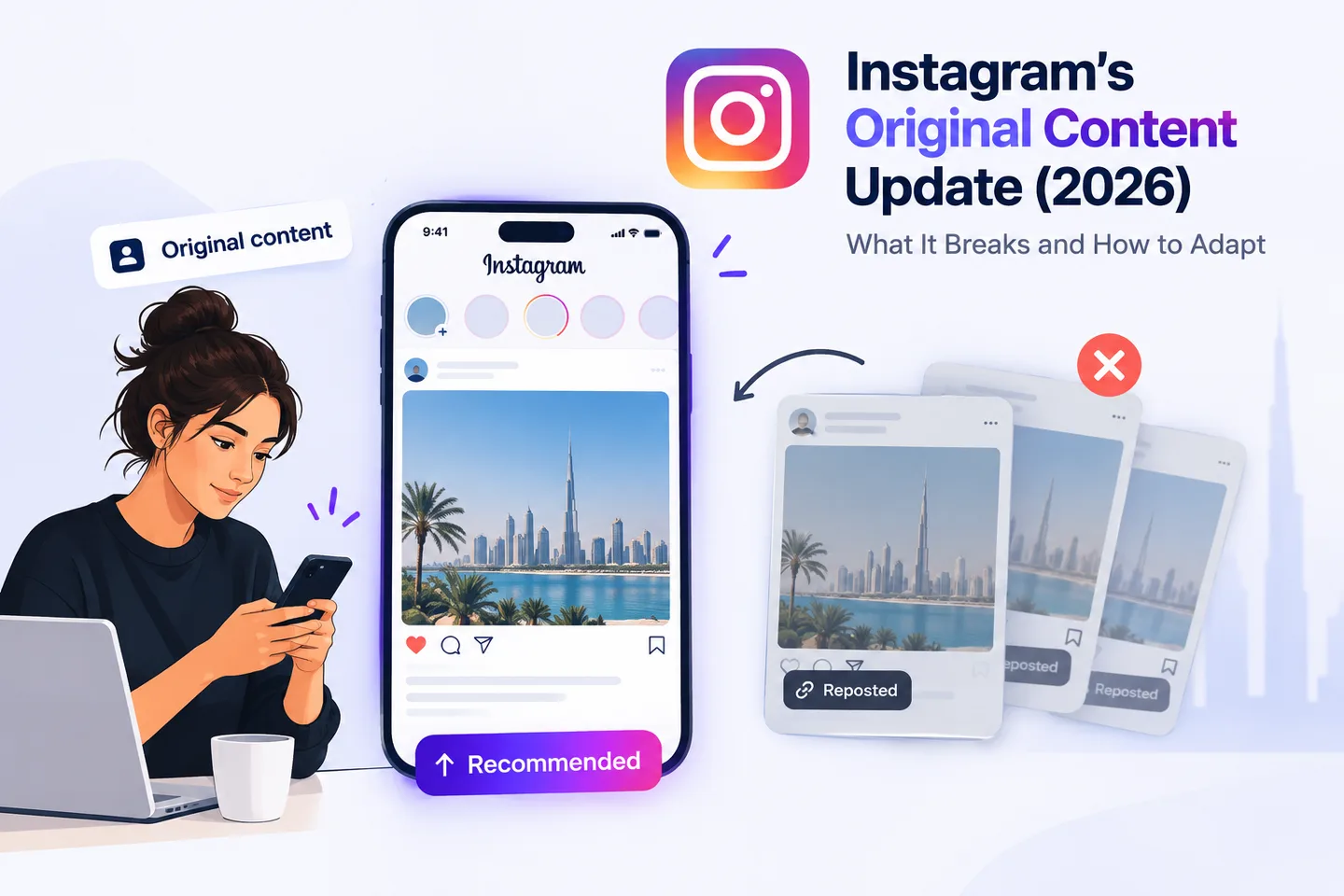
Instagram is changing its ranking systems to surface more content from smaller, original creators, rolling the changes out over the coming months.
The platform's own framing is unusually blunt about what it is correcting. Historically, creators with large followings and accounts that share reposted content have captured the most reach. Instagram says it now wants all creators to have an equal chance of finding an audience.
Three pieces of that announcement matter more than the headline:
- When Instagram finds two or more identical pieces of content, it will only recommend the original one.
- Creators whose work has been reposted without consent will be credited — an attribution label, applied for the first time, and reporting suggests Instagram may not let creators remove that label in future.
- Accounts built on reposting other people's content — meme pages, aggregators — are an explicit target.
The change follows months of creator complaints about reach, with Instagram head Adam Mosseri fielding them on Threads about as often as he announced features.
If your social workflow involves producing one asset and pushing it everywhere, this is the update that repriced it. Here is what actually breaks, and what to do about it.
Part 1: What "identical" means, and why it should worry you
The duplicate rule reads like an anti-piracy measure. It is broader than that in practice.
Instagram is not only talking about a meme page lifting a creator's Reel. It is describing a system that detects when the same piece of content exists in more than one place and then picks one to recommend. That logic does not check who deserved it in some moral sense — it identifies duplicates and ranks one.
Think about what that means for an ordinary brand workflow. A common setup looks like this:
- One video is produced
- It is posted to Instagram Reels, TikTok and YouTube Shorts, unchanged
- The same graphic goes to the Instagram feed and to Facebook
- A partner or a team member's personal account reshares it
- An agency account posts it for a roundup
In the old regime, that was efficiency. Under a duplicate-detection ranking system, every one of those copies is a candidate for being the one that is not recommended.
The practical risk is not a penalty. It is silent deprioritisation. Nobody tells you that your post was identified as the duplicate. You just see a number that is lower than it should be and conclude the algorithm hates you this week.
Part 2: This is the same correction LinkedIn made, from a different angle
Set this alongside what happened in the second half of 2026.
LinkedIn added a "seems like AI slop" reporting option in July, saw it used more than a million times within weeks, and by late August its Chief Product Officer said content classified as slop was getting roughly 40% fewer views. Meta announced in March that it would deprioritise and demonetise unoriginal, mass-produced content on Facebook. Instagram is now reranking around originality and attribution.
Three platforms, three mechanisms, one direction: the surplus of cheaply produced, duplicated, substanceless content became the platforms' problem, and they are solving it in ranking.
The reason is straightforward. When production costs collapse, feeds fill with content that is technically fine and worth nothing. Users disengage. Platforms lose the only thing they sell. So the ranking systems started looking for signals that distinguish content someone actually made from content someone merely generated or copied — and "is this the original?" is one of the cleanest signals available.
We wrote about the LinkedIn version of this in the slop crackdown. The Instagram version has a different trigger but the same strategic conclusion: originality is now a distribution variable, not a virtue.
Part 3: What else changed in Instagram's 2026 ranking
A few adjacent shifts matter for anyone planning a posting strategy. These are reported with varying confidence, so weight them accordingly.
"Your Algorithm" expanded to the main feed. Instagram has extended the feature that lets users see and edit the interests driving their recommendations, moving it from Reels into the feed. This is a real change with a real strategic consequence: when users declare interests rather than having them inferred from watch time, the platform gets stronger signals about who wants what. The effect is that broadly appealing content aimed at everyone gets less efficient, and clearly topical content aimed at a defined interest gets more efficient.
Topical consistency compounds. Practitioners have been describing an effect sometimes called "niche locking": an account that consistently posts on the same subject becomes easier for the system to classify and match to the right audience. Whether or not that is a named mechanism inside Instagram, it follows directly from how declared-interest matching works.
Shares and saves carry more weight than likes. This has been the direction for several years and the 2026 reporting reinforces it. A like costs nothing. A save means the content was worth keeping; a share means it was worth attaching your name to.
Carousels have a longer distribution window. Reporting puts the carousel window at around five days, up from roughly two. If accurate, it changes the economics of the format: a carousel that underperforms on day one is not dead, and carousels justify more production effort than a format with a 48-hour ceiling.
The common thread: every one of these rewards being specific and consistent about a subject, and punishes being generic and everywhere.
Part 4: What to change in your workflow
Six concrete adjustments.
1. Stop cross-posting the identical asset
This is the direct consequence of the duplicate rule, and it is the one that costs the most to ignore.
Every platform gets its own version. Not a different crop — a different piece. Different opening frame, different hook, different caption, different length, different structure. The underlying idea travels; the artefact does not.
This is more work. It is also the work the ranking systems are now paying for, and the alternative is paying the production cost anyway and having the copies compete with each other.
2. Publish the original on the platform that matters most, first
If the same idea will exist in several places, decide which one should be identified as the original. Post it there first, let it establish, and derive the others afterwards with genuine changes.
3. Sort out who posts what
If your content appears on a brand account, a founder's personal account, and a team member's account, decide the rule now:
- The brand account publishes the original.
- Personal accounts publish their own version — their own framing, their own commentary — not a copy.
- Resharing to Stories is fine; reporting indicates reposted Stories content no longer carries a ranking cost.
An employee reposting the brand's video verbatim to their own grid is now actively unhelpful to both accounts.
4. Anchor every post in something only you have
This is the structural fix and it has been the answer to every platform correction this year.
Content derived from something you own — your product, your data, your customers, your documentation, your decisions — cannot be duplicated by anyone else, because nobody else has the source. It is original by construction rather than by assertion. A post built from your own case study is not a candidate for duplicate detection. A repackaged industry statistic that forty accounts also posted this week is.
The practical version: every post traces back to a page, a number, a customer situation or a decision that exists in your business. If a draft has no such anchor, it is the kind of content the 2026 ranking systems are designed to filter out. We broke down the full workflow in turning your website into social content.
5. Pick a lane and stay in it
Declared-interest matching rewards legibility. An account that posts about one subject is easy for the system to place with the right audience. An account that posts about whatever happened that week is not.
Practically: define the two or three topics you are willing to be known for and decline the rest, even when something tempting trends. Reach that comes from a post outside your subject tends not to convert and tends to muddy your classification.
6. Optimise for saves and shares, not likes
Ask what would make someone keep this or send it to a colleague. Usually: a specific number, a process they can follow, a well-argued position, or a comparison that saves them an hour. Rarely: an inspirational observation.
Part 5: What this does not mean
Three corrections to the overreaction this update will produce.
It does not mean you cannot use AI. Originality and automation are different axes. A post drafted by a model from your own case study, edited by you, and published nowhere else is original. A hand-typed recycled industry listicle posted to four platforms unchanged is not. Platform data this year has consistently shown AI-assisted content performing above human-only baselines while fully AI-generated content performs below.
It does not mean small accounts will suddenly grow. Instagram's stated intent is to give all creators an equal chance of finding an audience, not to hand smaller accounts distribution. Equal footing means the content has to carry the post rather than the follower count. For a company with something specific to say and no audience, that is a genuine improvement. For an account posting generic content, removing the follower advantage removes the only thing that was working.
It does not mean cross-posting is banned. The same idea across platforms is normal and correct. The same file is what the system treats as a duplicate.
Part 6: A one-hour audit
Worth doing before the rollout completes.
Step 1 — Count your duplicates. Go through your last 30 posts across platforms. Mark every one where an identical asset was published in more than one place. That proportion is your exposure.
Step 2 — Check your anchors. For each of those 30, write the source it traces back to: a page on your site, a customer outcome, your own data, a decision you made. Posts with no source are your generic set. Compare the median saves and shares between anchored and unanchored posts — the gap is usually larger than teams expect.
Step 3 — Map your topics. List the subjects your last 30 posts covered. If the list runs past four, your account is hard to classify.
Step 4 — Fix the reshare rules. Write down, in one line each, what the brand account posts, what personal accounts post, and what gets reshared to Stories rather than reposted.
Step 5 — Set a floor. One rule, written down: every post is published in one place first, carries something only we have, and sits in one of our named topics.
Frequently asked questions
What is Instagram's original content update? Instagram is changing its ranking systems to surface more content from smaller, original creators. It will credit creators whose work is reposted, target accounts built on reposting others' content, and, when it finds two or more identical pieces of content, recommend only the original. The changes roll out over the coming months.
Does Instagram penalise reposted content now? Rather than a penalty, it is a ranking choice: where duplicates exist, the original is the one recommended. Reporting also indicates that resharing content to Stories no longer carries a ranking cost, so the effect is concentrated on feed and recommended content.
Will cross-posting the same video to Instagram and TikTok hurt my reach? The duplicate rule operates within Instagram, so the primary risk is the same asset existing more than once on Instagram itself. That said, platforms broadly favour native content, so adapting each version rather than exporting one file is the safer and generally better-performing approach regardless.
What is "Your Algorithm" on Instagram? A feature that lets users see and edit the interests driving their recommendations, now expanded from Reels to the main feed. It shifts recommendation signals from inferred interest toward declared interest, which rewards accounts that are clearly about a defined subject.
Does this help small accounts? It is intended to give all creators an equal chance of finding an audience by reducing the advantage of follower count and reposting. That helps small accounts with specific, original content and does little for small accounts posting generic content.
Can I still use AI to make Instagram content? Yes. This update is about originality and duplication, not about tooling. Platform engagement data through 2026 has shown AI-assisted content outperforming human-only baselines while fully AI-generated content underperforms — the variable is whether the substance is yours.
Will the repost credit label be removable? Instagram is applying attribution to reposted work, and reporting suggests the platform may not allow creators to remove the label in future. Treat it as permanent when planning.
How do I know if my content was treated as a duplicate? You will not be told. The practical signal is one copy of an asset performing normally while another underperforms with no other explanation. The reliable fix is not diagnosing it after the fact but not publishing identical assets in the first place.
Original by construction, not by effort
Every platform correction this year has converged on the same requirement, and it is a requirement most teams cannot meet by trying harder. You cannot will generic content into being original. You can only build it from something that is yours.
That is the whole design principle behind Fluxary. It pulls from your own website — your case studies, your product pages, your documentation, your pricing rationale — and turns that material into platform-native posts, adapted per channel rather than exported as one file, published on a schedule you control. The source is something only you have, which is the one property no ranking update can take away.
Turn your website into original content →
Summarised from publicly reported coverage as of October 2026, including TechCrunch's reporting on Instagram's original-content ranking changes and Adam Mosseri's announcement, plus trade coverage of the "Your Algorithm" expansion and 2026 Instagram ranking shifts. Some ranking details — carousel distribution windows, topical classification effects — are reported by practitioners rather than confirmed by the platform and should be treated as directional. Platform behaviour changes quickly; verify before building a strategy on any single figure.