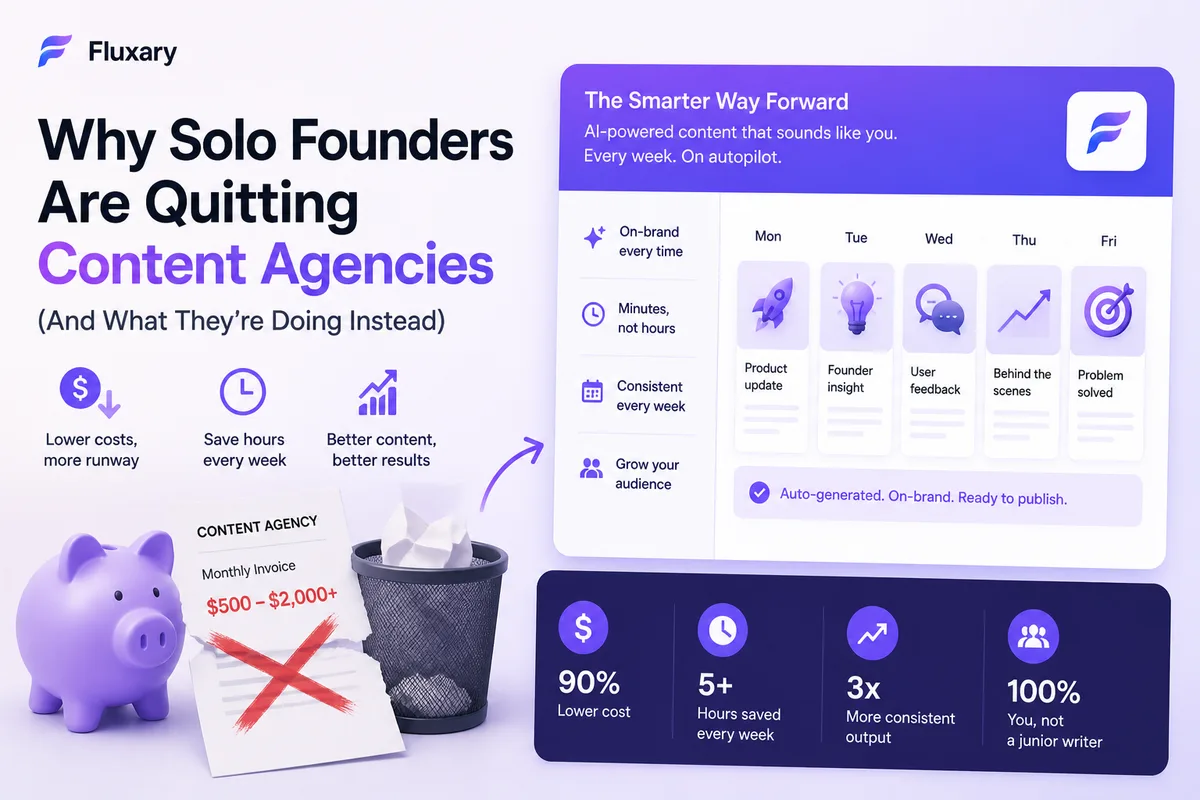
At $500–$2,000 a month, a content agency is one of the first line items a solo founder cuts when runway gets tight. But the founders leaving aren't only cutting costs — most of them are publishing more after they leave than they did while paying.
The Agency Promise vs. The Reality
The pitch is close to perfect: "We handle your social media so you can focus on building."
What tends to happen instead is messier. A junior writer who has never opened your product. Posts that are technically about your category but sound like they could belong to any of your competitors. A revision cycle that eats the afternoon you were supposed to get back. And an invoice arriving on the first of every month whether the work moved anything or not.
None of that means agencies are bad. It means the model assumes something you do not have: a marketing lead to brief them, review the output and own the result.
The Math Doesn't Work for Bootstrapped Founders
Content help for a solo SaaS founder is typically quoted somewhere in these ranges:
- Freelance writer, per post: $50–$200 — cheap until you multiply by four posts a week
- Part-time VA: $400–$1,200 per month, plus the time you spend training them
- Content agency retainer: $500–$2,000 per month, usually with a minimum term
- Fractional marketer: $2,000 and up, which is a real hire in everything but name
For a bootstrapped company those numbers compete directly with runway. But the sticker price is not the expensive part.
The expensive part is that none of these options remove you from the loop. You still write the brief. You still review the drafts. You still send the feedback and wait two days for version two. Founders routinely discover that outsourcing content saved less time than expected — especially in the first few months, while the agency is "learning the brand" on your clock.
The Hidden Cost Nobody Quotes
There is a second cost that never appears on the invoice: the delay between having a thought and publishing it.
You notice something in a support ticket on Tuesday. With an agency, that observation goes into a brief, gets scheduled, comes back Friday sounding slightly wrong, and goes live the following week — if it survives at all.
The timeliest, most specific, most you material is exactly the material that agency workflows filter out. What survives the process is the safe stuff. Which is why so much outsourced founder content reads like it was written by someone who read your homepage once.
The DIY Trap
The obvious alternative is doing it yourself, and that creates a different problem.
Most founders can write. That was never the constraint. The constraint is that a week of social content takes 4–8 hours once you include thinking of angles, drafting, making images, and scheduling — and that time comes directly out of product, sales and support.
The real cost of DIY content is not what you pay. It is what you did not build while you were making images in Canva.
What Founders Are Doing Instead
The third option is the one most of them land on: automate the production, keep the judgment.
The distinction matters. Generic AI content farms automate the thinking, which is why their output reads like nothing and converts like nothing. What actually works is narrower — a system that learns your specific brand, voice and audience, produces the drafts, and then hands them back to you for approval.
Because the bottleneck was never creativity. Deciding what to say is the easy part and takes about ninety seconds. Turning that into a formatted post, with an image that matches your brand, scheduled at a sensible time, on three platforms — that is the part that consumed your Sunday.
The Brand Consistency Problem — Solved Structurally
The most common complaint about outsourcing is drift. Posts feel generic. Your audience can tell it wasn't you. Six months in, the account sounds like a different company.
Drift happens because the brand lives in a human's memory of a briefing document. Tools that extract the brand from your site solve it differently: Fluxary reads your URL and pulls out your tone, value proposition, target audience and colours, then applies that same model to every post it generates — this month and next year.
There is no briefing cycle, because there is nothing to brief. There is no "this doesn't sound like us" revision, because the voice model is the input rather than the thing you keep correcting.
What Actually Changes in Your Week
The practical shape of it: you paste your URL once, and get a full month of posts — copy, AI images, and video where it fits — generated in one pass.
Then you review. Everything sits in an approval queue and nothing reaches your audience until you say so. You can edit any caption inline, swap an image, regenerate a post that missed, or move it to a different day. Approved posts publish to LinkedIn, Instagram and Facebook through the official APIs.
The month-in-one-sitting part is what makes it survivable for a solo founder; we walked through that workflow in how to create a month of social media content in one sitting.
Is This Right for You?
This swap tends to make sense if you are a solo founder or a team of two or three, bootstrapped or early-stage, publishing to LinkedIn, Instagram or Facebook, and currently spending more than three hours a week on production — or paying someone else to.
It makes less sense if you have a marketing hire who owns the channel, or if your growth depends on long-form research pieces rather than a steady social presence. An agency with real strategists earns its retainer for a company that has someone to receive that strategy.
The Bottom Line
Content agencies were built for companies with marketing teams, brand managers and editorial budgets. Solo founders don't have any of those, which is why the model keeps producing invoices and disappointment in roughly equal measure.
What a solo founder needs is not a content agency. It is a content system — one that runs every month without a briefing call and produces something that sounds like the person who built the product.
Plans start at $19/month; the pricing page has the details. The founders making this switch aren't just spending less. Most of them are publishing more consistently than they ever managed with an agency — and that consistency, not the savings, is what builds the audience.