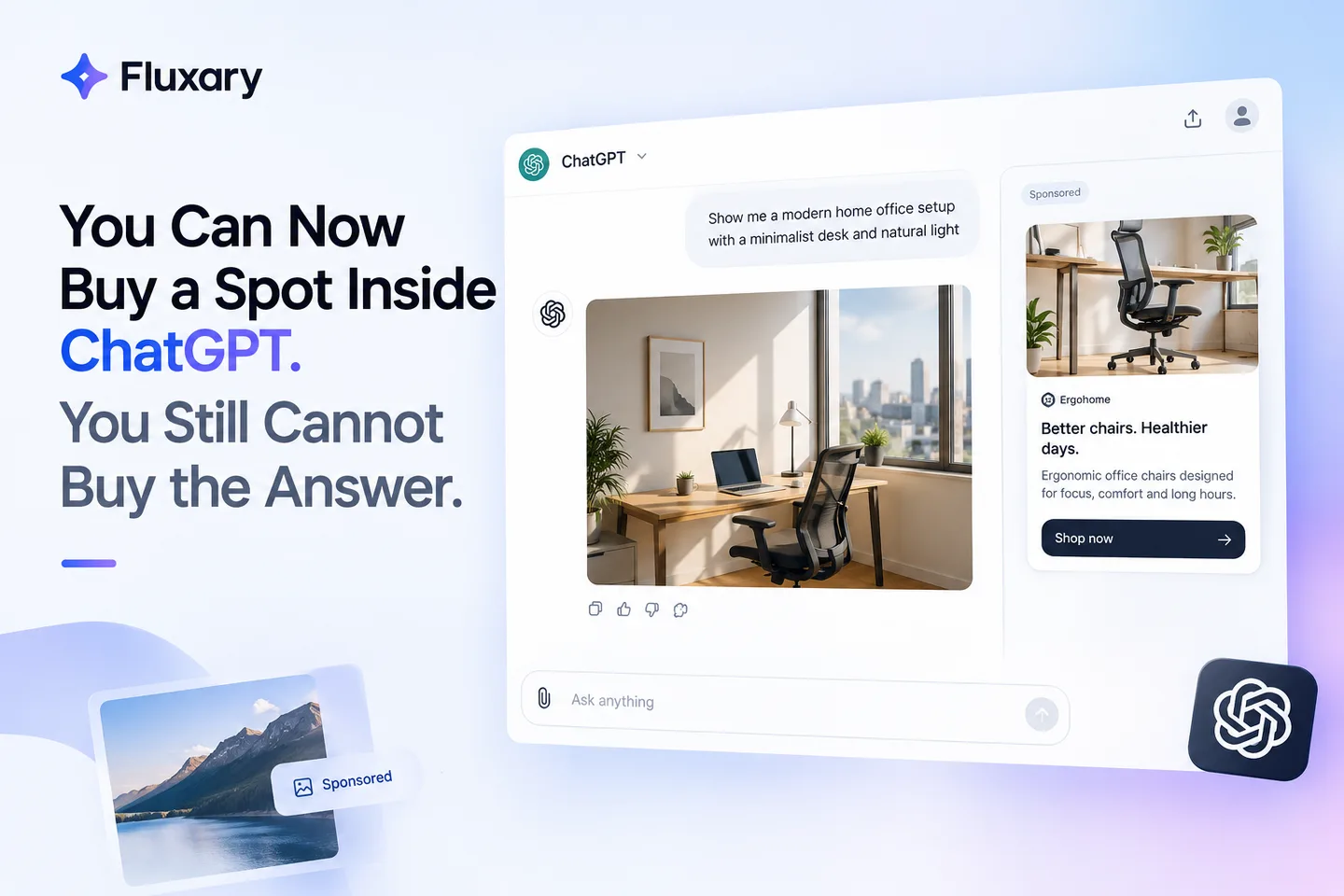
On 5 October 2026, OpenAI announced visual display ads that appear alongside images users ask ChatGPT to generate. They begin showing later this month, to an initial test group of advertisers, in the US only. The ads are clearly labelled, and OpenAI says they sit separate from the image and do not influence ChatGPT's answers.
The number behind it is the part that matters: ChatGPT has 1.2 billion weekly users. This is not the first step — OpenAI introduced ads earlier in 2026 on free and low-cost tiers and expanded them to India in August — but it is the step where the format becomes visual, the measurement stack becomes serious, and the thing stops looking like an experiment.
For anyone who has been treating AI assistants as the new organic channel, this is the moment that channel acquired a price list.
But there is a finding underneath the news that almost nobody is leading with, and it changes what you should actually do with your budget:
Buying an ad in ChatGPT does not appear to make ChatGPT recommend you. Early third-party tracking suggests advertisers show up in the answer itself, and get cited as a source, only a few percent of the time. Paid presence and organic recommendation are running as two separate systems.
This post covers what shipped, the data on paid versus organic, why the two systems are separate, and how a small company should decide whether to spend anything at all.
Part 1: What actually shipped
The specifics, as reported.
The format. Visual display ads beside generated images. The ad appears next to the image, not inside it. OpenAI's stated position is that the advertisement stays separate from the image being created and does not affect the response. Each one carries a clear label. The creative intent is product inspiration, product use, or an experience tied to a service — which is to say, it is designed for brands whose products benefit from being looked at.
The scope. US only, an initial test group of advertisers, beginning later in October 2026. No global rollout date has been announced.
The measurement stack, which is the real tell. Alongside the format, OpenAI expanded measurement into conversion signals, attribution and incrementality testing, with a partner list that reads like a mature ad platform rather than a pilot:
- Attribution: AppsFlyer, Triple Whale, Adjust, Rockerbox, Northbeam, Branch, Singular, Kochava, Airbridge, Tenjin
- Data integration: Hightouch, Tealium, LiveRamp, for pushing existing conversion data into ChatGPT Ads
- Full-funnel measurement: Fospha, Measured, INCRMNTAL
- Geo-based incrementality experiments: Haus, Measured, WorkMagic — described as exploratory
- Brand suitability pilots: DoubleVerify and Integral Ad Science, early-stage, with no finalised standards or independent validation published
A company running a one-off test does not wire up ten attribution partners. That list is infrastructure for a channel someone expects to be large.
The self-serve side. Reporting from late September describes an Ads Manager in beta for eligible US businesses, with budget, bid and pacing controls, entry reported at around a $25 daily budget — down from a pilot minimum reported in the region of $200,000 per advertiser — and average CPCs reported around $2 to $5. In that format the ad is described as a single sponsored card below the answer and its sources, with campaigns targeting conversational context rather than keywords.
Treat those economics as directional. They come from third-party trackers and vendors rather than from OpenAI, and the numbers in a beta move.
Part 2: The arc this completes
Zoom out, because this is the fourth instance of the same event in roughly six months, and the pattern is more useful than any single announcement.
Organic search stopped sending clicks. Analysis of US Google searches from early 2026 found less than a third still send a click to the open web. Google's AI Mode refers at roughly 1.6–2.5% of queries against 17–19% for traditional search. We covered that in zero-click marketing.
Paid search stopped being steerable. Through September 2026 Google force-migrated broad match and ACA Search campaigns to AI Max, with no opt-out, enabling search term matching and — for ACA campaigns — text customisation by default. Covered in the AI Max migration.
Social started filtering mass-produced content. LinkedIn's slop crackdown put classified content down roughly 40% in views. Instagram is reranking toward original content and, where it finds duplicates, recommending only the original. Covered in the slop crackdown and Instagram's original content update.
And now the answer layer itself has inventory.
Read in sequence, these are not four unrelated platform stories. They are one process. Every surface that offered free, scalable, organic distribution has — within about two quarters — either stopped sending traffic, stopped being controllable, started filtering volume, or started selling placement. In several cases, more than one.
The strategic conclusion has not changed since the first of these. It has just stopped being arguable: rented distribution is being repriced across the board, and the only durable asset is material you own, distributed directly.
Part 3: The finding that should change your budget
Here is the part worth paying attention to.
The intuitive read of "ChatGPT now has ads" is that you can now buy your way into the answer. Early measurement says you cannot.
Seer Interactive's tracking of 3,697 ads found advertisers appeared in the response itself 5.4% of the time and were cited as a source 3.3% of the time — with both figures reported as falling further over the tracking period.
SE Ranking's study of 50,006 commercial prompts found advertisers were also cited organically in only 3.63% of paid placements.
Two independent datasets, same conclusion: the sponsored slot and the recommendation are separate things, and buying one does not get you the other. That is consistent with OpenAI's own stated position that ads remain separate from the answer.
There is a corollary worth stating, because people will get it backwards. When brand citation rates have moved this year, the likely causes have been model releases and algorithm shifts rather than ads — one tracker observed an early-2026 drop in brand-query citations followed by a recovery, attributed to model changes, and found algorithm shifts predating the ads announcement entirely. So: ads did not cost you your citations, and ads will not buy them back.
What ads do change is the context around the answer. A sponsored card sits next to the recommendation, and it may well be a competitor's, or a loosely related brand's. You are not buying the verdict. You are buying adjacency to it.
Part 4: Why these are two separate systems
This is worth understanding structurally, because it predicts what happens next.
An ad auction answers the question who paid the most for this context? It is a market. It clears in milliseconds and the inputs are budget, bid and targeting.
An answer engine's citation answers a different question: what does the model understand to be true about this category, and which sources does it trust enough to name? The inputs are entirely different — entity clarity, third-party corroboration, consistency of description across many surfaces, and the model's training and retrieval. None of those are purchasable in an auction, and the gap is wide: research through 2026 has repeatedly found that fewer than 10% of sources cited by major AI assistants rank in Google's organic top 10 for the same query. Even Google's own ranking does not predict AI citation. A ChatGPT ad buy certainly does not.
Which means the two systems fail in different ways, and need different fixes:
| Paid placementOrganic citation | The question it answers | Who bid? | Who is understood and trusted? | Time to influence | Hours | Months | What moves it | Budget, bid, creative | Entity clarity, corroboration, consistency, distribution | What it stops doing when you stop paying | Everything, immediately | Nothing, immediately | Where it shows | Labelled sponsored slot | Inside the answer |
The second column is the one that compounds, and it is the one small companies systematically underinvest in because it has no dashboard.
Part 5: What to actually do
Five steps, in order, and the order matters.
1. Measure your organic position before you spend anything
You cannot evaluate incremental lift from a baseline you never took. Before bidding on anything:
Build a fixed set of 20–40 prompts a real buyer would type — not keywords, prompts. "Best tool for X." "Alternatives to Y." "How do I solve Z." Include your branded prompts and your competitors' names.
Run them monthly, on a schedule, across ChatGPT, Gemini, Perplexity and Google AI Mode. Record four things per prompt: whether you were mentioned, whether you were cited as a source, which competitors appeared, and which domains were cited.
Keep the file. In six months the trend line is worth more than any single reading, because single readings in this space are noisy — the same prompt can return different brands on different days.
2. Sort each high-intent prompt into one of three buckets
This is the decision framework, and it tells you where money actually belongs:
Not cited at all. Do not buy ads. Fix organic first. An ad next to an answer that recommends someone else is paying to stand beside your competitor's endorsement. The work here is entity clarity and corroboration: being described consistently across your own site, third-party lists, reviews, documentation and your social footprint.
Cited, but someone is advertising on your prompt. Find out who. A competitor buying adjacency to a recommendation of you is a specific, addressable situation, and it is the clearest case for a defensive buy.
Cited and considering ads. This is the only bucket where a test makes sense — and run it as an incrementality test, not an attribution test. The question is whether the ad produced clicks you would not otherwise have had, given that you were already being recommended.
3. Keep the reporting separate
Ads Manager will show you impressions, clicks, CPC and conversions. It will not show you the prompt that triggered the placement, and it will not show you your organic share of that prompt.
So do not merge them into one "AI visibility" number. Track paid presence, organic mentions and organic citations as three distinct metrics. A rising paid number next to a falling citation number is a real and common situation, and a blended metric hides it completely.
4. Watch for convergence, and be ready to be wrong
The honest caveat: this is a beta, and the separation between ads and answers is a current design choice, not a law of physics. OpenAI's stated position is that ads do not influence answers, and the data supports that today.
Things to monitor quarterly: how often advertisers appear in answer bodies, citation counts on commercial prompts, and whether advertiser domains start appearing in source lists at rates above the current few percent. If those numbers move, the strategy moves with them.
5. Do not treat this as a reason to stop the slow work
The temptation when a new ad channel opens is to move budget into the thing with a dashboard. Resist it in proportion to how small you are.
A large brand with existing category authority can buy adjacency and benefit, because the recommendation is already theirs. An unknown company buying ChatGPT ads before being citable is buying presence beside someone else's answer — and when the budget stops, so does the presence, with nothing accumulated.
Part 6: What this means if you are small
Three practical conclusions.
The entry price is now low, which is a trap as much as an opportunity. A reported $25 daily entry is accessible to almost anyone, and that is exactly what makes it easy to spend six months of small budgets on a channel that was never your constraint. Your constraint is almost certainly that the models do not have enough corroborated material about you to describe your category position at all.
The visual format is narrow. This launch sits beside image generation and suits brands whose products benefit from imagery and inspiration. If you sell B2B software, an ad beside someone's generated image is not where your buyer is. Wait for formats that match your intent.
The compounding asset is still the same one. Being described consistently, by many sources, in terms you chose, is what makes a model able to name you. That is built by publishing specific material you own and distributing it widely enough to be corroborated — the exact thing that also survived the slop crackdown, the originality rerank and the collapse of organic click-through. One behaviour, four separate platform corrections, same answer.
Frequently asked questions
What did OpenAI announce on 5 October 2026? Visual display ads that appear alongside images users ask ChatGPT to generate. They begin appearing later in October, US only, with an initial test group of advertisers. The ads are clearly labelled and, per OpenAI, remain separate from the image and do not influence ChatGPT's answers.
How many people will see ChatGPT ads? ChatGPT has 1.2 billion weekly users. The current visual ad test is US-only, so the addressable reach today is a fraction of that, with global rollout not yet dated.
Do ChatGPT ads improve your organic citations? Current evidence says no. Seer Interactive's tracking of 3,697 ads found advertisers appeared in the response 5.4% of the time and were cited 3.3% of the time, with both declining over the period. SE Ranking's study of 50,006 commercial prompts found advertisers cited organically in only 3.63% of paid placements.
Did ChatGPT ads cause brand citation rates to drop? Unlikely. Trackers attribute observed citation movements this year primarily to model releases and algorithm shifts, with some changes predating the ads announcement. Ads neither caused the drops nor fix them.
How much do ChatGPT ads cost? Third-party reporting on the self-serve Ads Manager beta describes entry around a $25 daily budget, down from a pilot minimum reported near $200,000 per advertiser, with average CPCs reported around $2 to $5. These figures come from trackers and vendors rather than OpenAI, and beta pricing moves.
Where do the ads appear in the answer? The October visual format appears beside generated images. The self-serve format is described as a single sponsored card below the answer and its sources. Campaigns are described as targeting conversational context rather than keywords.
Has ChatGPT had ads before this? Yes. OpenAI introduced ads earlier in 2026 to support free and low-cost subscription tiers, and expanded them to India in August 2026. The October announcement adds a visual format and a substantially expanded measurement stack.
Should a small company buy ChatGPT ads? Only after measuring organic position. If a buyer prompt does not cite you at all, an ad places you beside a recommendation of someone else. If you are already cited, an incrementality test is reasonable. The low entry price makes it easy to spend on a channel that is not your actual constraint.
How do I track whether AI assistants mention my brand? Build a fixed set of 20–40 buyer prompts, run them monthly across ChatGPT, Gemini, Perplexity and Google AI Mode, and record mentions, citations, competing brands and cited domains separately from any paid metrics. Single readings are noisy; the trend over months is the signal.
The channel you own is the one nobody reprices
Four platform corrections in six months, each one making free distribution scarcer or more expensive, each one pointing at the same hedge.
Models describe you accurately when enough corroborated material about you exists, in your own terms, across enough surfaces. That is not an ad buy. It is the accumulated effect of publishing specific things you own and putting them where people and crawlers find them — consistently, for months.
Fluxary does the mechanical half of that. It takes what is already on your website — your case studies, product pages, documentation, pricing rationale — and turns it into platform-native posts, adapted per channel rather than copied, published on a schedule you control. You keep the claims and the judgment. It keeps the consistency that corroboration actually requires.
Turn your website into a channel you own →
Sources: TechCrunch on OpenAI's 5 October 2026 visual ads launch and the 1.2 billion weekly user figure; Yahoo Finance on the measurement and attribution partner list; Topify summarising Seer Interactive and SE Ranking tracking of paid placements versus organic citations, and self-serve Ads Manager economics — note this source is a vendor selling AI-visibility tracking tools, and the underlying Seer and SE Ranking figures should be checked against those firms directly before being used in planning. Pricing and placement details for the Ads Manager beta are third-party reported rather than confirmed by OpenAI. This is a fast-moving beta; verify against OpenAI's own documentation before committing budget.