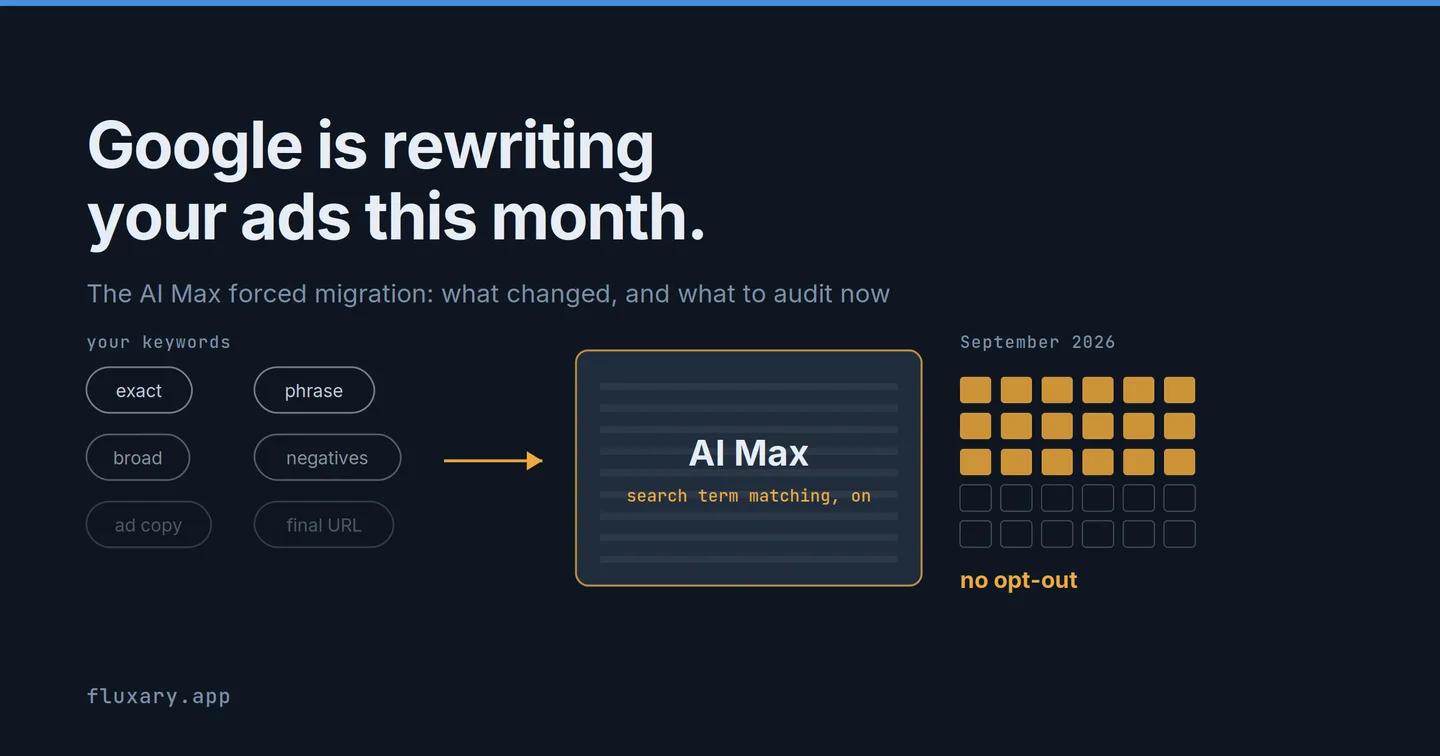
Google Is Rewriting Your Ads Right Now
If you run Google Search campaigns, there is a reasonable chance your account was changed this month without anyone on your team touching a setting.
Between 1 and 30 September 2026, Google is automatically upgrading every eligible Search campaign to AI Max for Search. Eligible means the campaign still uses the campaign-level broad match setting or legacy Automatically Created Assets (ACA). The migration happens in place, campaign by campaign, spread across the month.
There is no opt-out. The only window to avoid the automatic mapping closed on 31 August. Advertisers who wanted to control the transition had to either disable the legacy features beforehand or enable AI Max themselves with each toggle set deliberately.
Practitioners have described exactly what this feels like from the inside: logging into a long-running client account one morning in September and finding campaign settings changed overnight, with no warning from the platform side.
This post covers the verified timeline, what actually changes in your account, what the independent performance data says (it disagrees with itself, and that matters), the audit to run this week, and the strategic conclusion that goes beyond Google Ads.
The timeline, stated precisely
The dates moved more than once during the announcement cycle, so it is worth being exact.
| DateWhat happened | |
| 5 August 2026 | Google notified affected advertisers directly by email |
| 3 August 2026 | Creation of new campaign-level broad match and legacy ACA configurations blocked across the Ads UI, Ads Editor and API |
| 12 August 2026 | Google published the technical mechanics on the Ads Developer Blog |
| 1–30 September 2026 | Automatic migration of broad match and ACA campaigns to AI Max, rolling gradually through the month |
| September 2026 | In-account notices begin encouraging voluntary Dynamic Search Ads upgrades |
| 15 January 2027 | Reminder notifications to advertisers with legacy DSAs |
| 1–28 February 2027 | Automatic DSA migration; creating new DSA ad groups permanently removed |
Note the sequencing on that second row. The creation freeze landed before the developer documentation was published. The population of affected campaigns has been frozen since early August, which means you can enumerate exactly which of your campaigns were in scope.
Dynamic Search Ads are not in the September window. That migration was pushed to February 2027, with the API sunset following later in 2027. If you have been reading that DSAs are being migrated now, that reporting is out of date.
What actually changes in your account
AI Max is not a new campaign type. Google's own documentation frames it as an optimisation layer activated within existing Search campaigns. Your campaign IDs, budgets, bids and ad copy survive the migration. What changes is the matching and asset logic underneath.
The defaults differ by what you were running:
Campaigns using Automatically Created Assets arrive with search term matching and text customisation both enabled by default.
Campaigns using campaign-level broad match arrive with search term matching only — no automatic text customisation, no final URL expansion.
Carried over unchanged: brand inclusions and exclusions, budgets, bid strategies.
Two of those defaults deserve unpacking, because they are the ones that change what your advertising is.
Search term matching
Search term matching reaches beyond your keyword list, matching queries on intent rather than on keyword — much the way Performance Max already operates. In practice your account can begin serving against net-new queries nobody added, reviewed or approved.
This was already happening in the background before the migration. By August 2026, AI Max was reportedly capturing around 29% of exact-match keyword impressions even in accounts that had not explicitly enabled it. September makes implicit behaviour explicit and mandatory.
Text customisation
This is the one most advertisers underestimate. Text customisation means Google rewrites your ad copy to match the query it decided to serve against.
If your brand has specific terminology, a controlled claim set, or regulated language — financial services, healthcare, anything with compliance review on copy — a system rewriting your headlines per query is not a performance setting. It is a brand and compliance exposure. Text customisation can be turned off at the ad-group level after migration, and for many advertisers that should be the first post-migration action rather than a later optimisation.
The performance data disagrees with itself
This is the part where most coverage picks a side. The honest position is that the evidence is genuinely mixed, and you should know that before deciding how much to intervene.
Google's claim: approximately +7% conversion lift from the full feature suite.
Smarter Ecommerce, measuring across more than 250 retail campaigns, reported a median 13% increase in conversion value with a median ROAS difference of 0%. Read that carefully: more conversion value, same efficiency. That is a volume effect, not an efficiency gain — useful if you are budget-unconstrained, neutral-to-irrelevant if you are not.
At least one other analysis of a similarly sized retail campaign set reported a roughly 35% ROAS drop, describing a large gap between platform claims and advertiser-measured results.
Those two retail findings are difficult to reconcile, and anyone telling you confidently which is right is guessing. What that variance most likely reflects is that AI Max performance depends heavily on account conditions — conversion data volume, landing page quality, tracking cleanliness and account structure. Systems that learn from data do well where there is data and badly where there is not.
Lunio measured a separate risk: AI Max invalid-traffic rates rising from 2.46% to 5.28% over nine months, while standard Search ended the period at 3.07%. Broader matching means broader exposure to low-quality traffic.
Alphabet's own filings show the macro picture: paid clicks accelerating — roughly 6% growth in 2025, then 13% in each of Q1 and Q2 2026 — while CPC growth slowed across the same period (7%, then 5%, then 3%). More clicks, cheaper clicks. Whether those additional cheaper clicks are worth having is precisely the question the conflicting studies are arguing about.
The practical read for a small advertiser: if you have low conversion volume and a tight budget, you are in the account conditions where AI Max has the least to learn from and the most room to spend your money exploring. Budget constraints limit the query volume the system needs, which means a small account can absorb the exploration cost without ever reaching the performance the case studies describe.
The eight-point post-migration audit
Run this on every migrated campaign. It takes an afternoon.
1. Confirm which campaigns migrated. Identify every campaign that was using campaign-level broad match or ACA before September. Those are your affected set.
2. Baseline your search terms report — with the right date range. Pull the search terms report for August, before migration reached your account. You need a pre-migration baseline to compare matching behaviour against. If you did not pull one, use the earliest available September data and note where in the month your campaigns actually flipped.
3. Decide on text customisation explicitly. If your ACA campaigns migrated, text customisation is on. Decide whether you want a system rewriting your headlines. For regulated or claim-sensitive categories, turn it off at the ad-group level.
4. Rebuild your negative keyword lists. Broader matching makes negatives load-bearing rather than tidy-up. Review the new search terms weekly for the first month and add negatives aggressively.
5. Re-confirm brand inclusions and exclusions. These are reported to carry over automatically. "Reported to" is not "verified in your account." Check them.
6. Verify conversion tracking, location targeting, ad schedules and tracking templates. Most platform migrations carry controls over cleanly, but a verification pass is cheap and a broken tracking template during a matching change is very expensive.
7. Check your landing page and query alignment. AI Max sends traffic from queries you did not write. If your landing page only answers one narrow intent, broader matching will send traffic that bounces. Either narrow the matching or broaden the page.
8. Watch invalid traffic. Given the measured rise in invalid-traffic rates, monitor your click quality alongside your conversion numbers rather than assuming volume growth is real growth.
The bigger pattern: control is being withdrawn across the stack
Google is not an outlier here. Microsoft made its own AI Max generally available and switched it on by default. Amazon enrolled Sponsored Products campaigns into equivalent automation. The direction is uniform across the major ad platforms in 2026.
Practitioners have noticed. In the State of PPC 2026 survey of 1,306 respondents, 53% said Google Ads is harder to manage than it was two years ago, and 62% said the platforms make decisions they cannot manually override.
Set that alongside the other structural shift of this year: less than a third of Google searches now send a click to the open web, and AI Mode refers at roughly 1.6–2.5% of queries against 17–19% for traditional search.
Put the two together and the picture is uncomfortable. The organic channel stopped sending traffic. The paid channel still sends traffic, but you increasingly cannot steer it, cannot see the queries in advance, and — with text customisation — cannot fully control the words attached to your brand.
Both changes have the same root cause and the same strategic implication: the marketing assets you rent are getting less controllable, and the ones you own are getting more valuable.
The hedge: own the parts nobody can auto-migrate
There is no configuration that gives you back manual control of Google's matching layer. What there is instead is a portfolio decision.
Three things remain fully under your control:
Your website. Nobody rewrites your product pages at 2am. This is the only surface where your positioning, claims and terminology are exactly what you wrote.
Your distribution. Publishing your own material, in your own words, to the channels where your audience already is. No matching layer decides what it says. No optimisation layer rewrites the headline.
Your brand recognition. The compounding asset. It makes branded search happen, and branded search is the one query type that still reliably clicks through — research this year found click-through rates rising around 18% for brand-name searches even with AI Overviews present.
None of this argues for abandoning paid search. AI Max may well work fine for your account, and the Smarter Ecommerce volume finding is real. It argues for not being only on rented surfaces while every rented surface simultaneously reduces what you can control.
The practical version: while you are auditing your migrated campaigns this week, also make sure there is a channel where your message reaches people without passing through an optimisation layer. For most small companies that means taking the substance already sitting on their website and distributing it directly rather than only buying clicks to it.
Frequently asked questions
Can I opt out of the Google AI Max migration? Not once the window began. The only opt-out was disabling campaign-level broad match or Automatically Created Assets before 1 September 2026, or enabling AI Max yourself with settings chosen deliberately. Within the 1–30 September window, eligible campaigns migrate automatically with no rollback.
Which campaigns are affected? Search campaigns using the campaign-level broad match setting or legacy Automatically Created Assets. Dynamic Search Ads are not in this window — their migration is scheduled for 1–28 February 2027.
Is AI Max a new campaign type? No. Google describes it as an optimisation layer activated within existing Search campaigns. Campaign structure, IDs, budgets and bid strategies carry through the upgrade.
What settings are enabled by default after migration? ACA campaigns receive search term matching and text customisation enabled by default. Campaign-level broad match campaigns receive search term matching only, without text customisation or final URL expansion. Brand inclusions and exclusions carry over.
Can I turn text customisation off after migration? Yes — it can be adjusted after migration, including turning it off at the ad-group level. If your category is regulated or claim-sensitive, this is worth doing before you optimise anything else.
Does AI Max improve performance? The evidence is mixed. Google claims roughly +7% conversion lift. One study across 250+ retail campaigns found a median 13% increase in conversion value at a median 0% ROAS difference; another reported a roughly 35% ROAS drop. Performance appears highly dependent on conversion data volume, landing page quality and account structure, which is likely why the results diverge so widely.
What is search term matching? Matching that reaches beyond your keyword list, serving against queries based on intent rather than keyword — similar to how Performance Max operates. Your account can serve against queries nobody on your team added.
What should a small advertiser do right now? Audit the migrated campaigns, decide on text customisation explicitly, rebuild negatives, baseline your search terms, and watch invalid traffic. Small budgets give the system the least data to learn from, so tighter manual controls matter more, not less.
Build something the platform cannot change overnight
The lesson of September 2026 is not that AI Max is bad. It is that the settings you rely on are not yours, and they can change on someone else's timeline with two weeks of notice sent to an email you may not have read.
Fluxary is the other half of the portfolio: it turns your website — the one asset nobody auto-migrates — into on-brand social content published on a schedule you set. Your words, your claims, your terminology, reaching people directly. No matching layer, no text customisation, no migration window.
Turn your website into a channel you own →
Timeline and mechanics summarised from Google's Ads Developer Blog post of 12 August 2026 and Ads and Commerce Blog updates as reported by Search Engine Land and other trade coverage, verified against independent summaries published in early September 2026. Performance figures cited from Smarter Ecommerce, Lunio, PPC Land, Alphabet quarterly filings and the State of PPC 2026 survey as publicly reported. Platform behaviour and documentation change frequently — verify against Google's current documentation before acting on any specific setting.